Kaka’ako Makai is a new landscape for urban redevelopment in Honolulu, Hawaii that draws upon design features inspired by walkability, entrepreneurship and a sharing economy. Bound by Ala Moana Beach near Waikiki to the east and downtown Honolulu and Honolulu Harbor to the west, the region is designated as Oahu’s “third city” (trailing after Kapolei in 2nd and Honolulu in 1st). Design elements include mixed-use zoning for local small business and affordable housing, conservation technologies, and an interpretation of the region’s historic sites.
The Kaka’ako Makai’s guiding vision incorporates rhetoric of distinct Hawaiian culture, specifically ahupua‘a and kuleana. Ahupua’a implies environmentally responsible land use decisions and kuleana suggests a sense of responsibility to the island and those who live there.
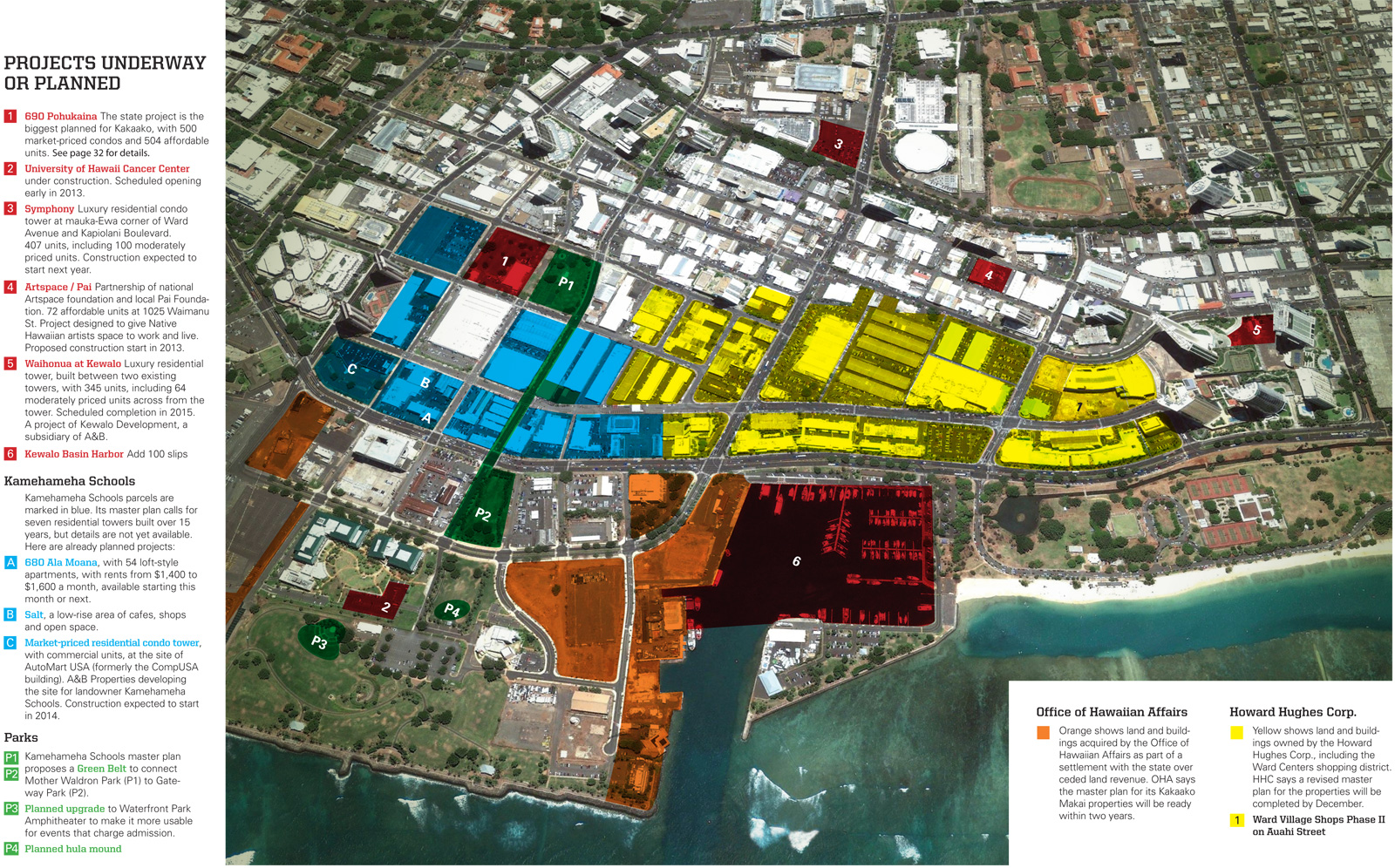
Kaka’ako Makai is being developed alongside a large homeless encampment and amidst a crisis in transit congestion, wastewater treatment, and housing affordability across the island. In reviewing both the Kaka’ako Makai Conceptual Master Plan and critical portrayals of the developments in progress, my examination into how this urban revitalization project upholds it’s intended mission finds a local connection to place delivered through collective responses to the planning process.
Organizations rooted in Kaka’ako, along with local allies, have emerged in a groundswell of voices championing a distinct claim to the district as one that serves local desires and needs. The Community Planning Advisory Council recommendations calls for a “Hawaiian sense of place” captured through native fauna and flora, as well as nods to the historic significance of the neighborhood. The small business owners who operate out of Kaka’ako Makai and the everyday users of the surf, parks, and businesses there, create an alternative sense of place that is ingrained in the lifestyles of today’s Hawaiian culture.
In 2016, the American Planning Association partnered with the University of Hawaii Manoa to develop courses that were free and open to the public with the mission of educating attendees on the planning process that would inevitably change the landscape of Kaka’ako. The series, “Kaka’ako: Our Kuleana,” discussed traffic circulation, wastewater management, development impacts on small businesses and much more. Nan Ellin (2013) suggests that developments constructed under such conditions (e.g. popular education models, etc.) operate using an “integral urbanism.” Integral urbanism develops “authenti-cities” that are “responsive to community needs and tastes, which have to do with local climate, topography, history, and culture” (594). These types of planning processes contrast master planning “which, in its focus on controlling everything, has tended ironically to generate fragmented cities without soul or character” (Ellin, 594). Ellin goes on:
This new millennium has been spawning the “Re-generation,” with a clear-eyed vision and the courage to Re-build our towns and cities, Re-vitalize our communities, Re-store what has been taken from the earth and Re-align design with the goal of supporting humanity” (598).
Ellin’s critique of planning practices that result in fragmentation makes use of a rhetoric of “re-” prefixes to bring attention to holistic thinking that takes into consideration the history and living experiences of those human and non-human beings making good use of current environments.
The “Re-generation” is driven by Kaka’ako Makai community members and allies, whose collective presence calls into question just what a Hawaiian sense of place might mean, and to whom.
Further Readings
Kaka’ako Makai Conceptual Master Plan – Hawaii Community Development Authority
 sarah mercurio