Mega events such as the Tokyo 2020 Olympic Games heighten national security concerns, often provoking use of state power in ways that result in discrimination against citizens and foreigners alike. Japan is no exception.
In the summer of 2017 the UCLA Urban Humanities Initiative awarded a grant to travel to Tokyo, Japan to examine the surveillance being used in preparation for the 2020 Olympics, as well as policy implications and media perceptions of those strategies. My colleague, Sabrina Kim, and I were tasked with understanding the policies and activities that created a sense of fearlessness in tourists, while constraining the everyday experiences of Tokyo’s citizens. Among these citizens were a growing Muslim population, both in foreign-born Muslims and Japanese converts.
Our research was primarily internet and interview based. An examination of policy documents and news articles exploring reactions to policy set the stage for our one-on-one interviews and site visits to Muslim landmarks in Tokyo. We were hosted by a generous design lab at Waseda University who we joined at a presentation and exhibition, Ghost Guides to Tokyo 2020: Exposing Latent Impacts of Urban Mega-Events, where we share the culmination of our findings.

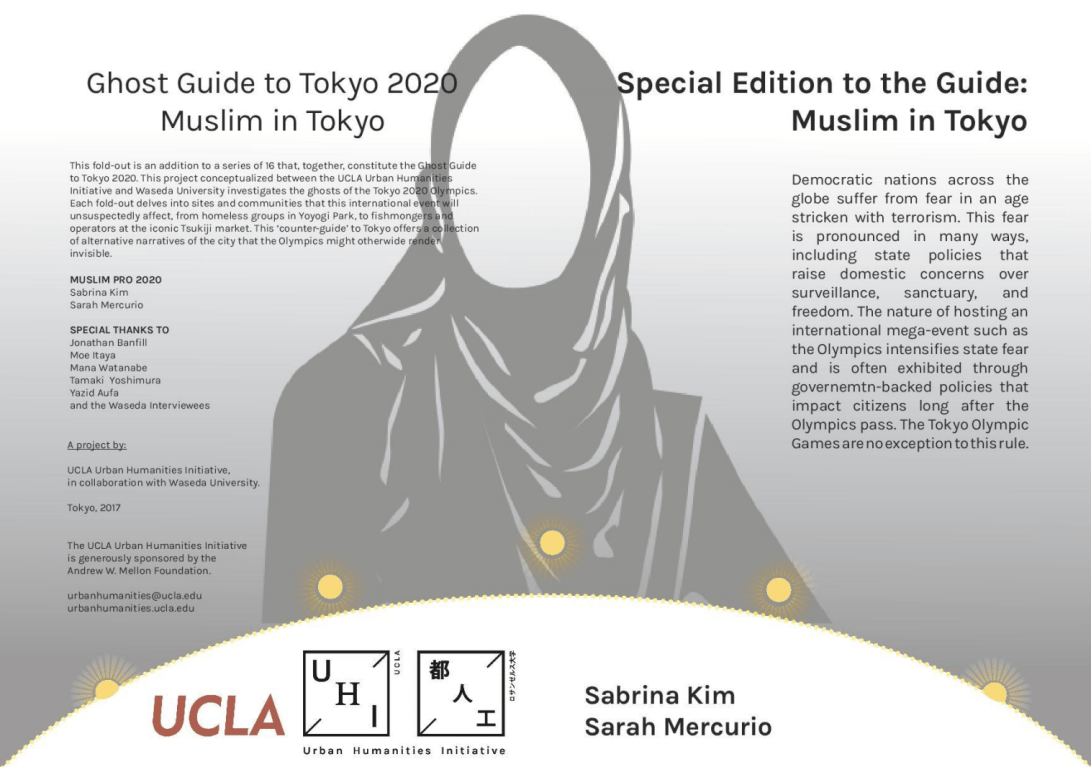
Our final guide, Muslim in Japan, traces the historic arc of Muslim population growth and social embrace in contrast to political attitudes and enacted policy. A paradox was identified between lived experience and policy; our interviews did not reveal any feelings of overt surveillance or discrimination, thought bills were being passed (most recently, the 2017 Anti-Conspiracy bill) and reports were being leaked that clear discrimination against Muslims was well underway. While hospitality was being expressed toward an international audience, internal government decisions were criminalizing the Muslim population.
Our research did not explore the parallels Japan’s surveillance strategies had with other Olympic’s host countries, though I think that would be a worthy exploration to pursue. Given that the 2017 Anti-Conspiracy bill is written in notably vague language, it’s application throughout the next two years will be one to keep our eyes on.
Read more about our research at UCLA’s Urban Humanities Institute, or check out our presentation.
 sarah mercurio